


Bermad


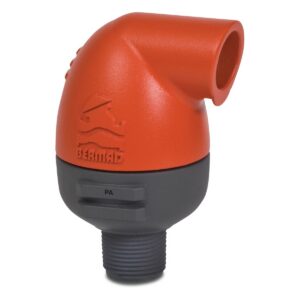

Bermad air valves and pressure reducing valves for pool and irrigation pipework
Air trapped in a pressurised line is a nuisance at best and a hazard at worst. It reduces flow, causes pressure surges when it moves, upsets flow readings and can leave pumps struggling against a cushion of air rather than water. Draining the same line creates the opposite problem: a vacuum that can collapse thin-walled pipe or pull seals inwards. The valves listed here deal with both situations automatically, and the pressure reducing valve on this page handles a related issue — supply pressure that is simply higher than the equipment downstream was built for.
Here you will find a compact selection of Bermad valves in glass-filled nylon and fibreglass-reinforced nylon bodies, in threaded sizes from 3/4″ to 2″, with pressure ratings stated on each product. These are the components that sit at the high points of a buried ring main, on top of a filter manifold, or immediately upstream of a pressure-sensitive circuit.
Air release, vacuum break and combination valves
The terminology matters when choosing, because the three functions are not interchangeable:
- Air release (automatic) function — a small orifice that continuously bleeds off the fine air that accumulates during normal operation, while the line stays pressurised.
- Vacuum break (anti-vacuum) function — admits air back into the pipe when the pressure drops towards or below atmospheric, typically during draining, winterising or a pump stop.
- Kinetic (large orifice) function — discharges the large volume of air pushed ahead of the water when an empty line is filled, then closes as the water arrives.
- Combination valves — such as the C30 range, bring the large-orifice and small-orifice functions together in a single body, so one fitting covers filling, operation and draining.
The K10 in 3/4″ male thread suits smaller branch lines and individual pieces of equipment, while the 2″ male C30 is intended for main lines where a large air volume has to move quickly. Note that the C30 appears here in two pressure ratings, 10 bar and 16 bar, with otherwise similar connections — check the working pressure of your system, including surge, before deciding which is appropriate.
Pressure reducing valves
A pressure reducing valve holds a set downstream pressure that is lower than and largely independent of the inlet pressure, so filters, heat exchangers, dosing equipment and flexible hose see a stable figure rather than whatever the mains or the pump happens to deliver. The 1″ female threaded model listed here (reference 2U1010C) is a fibreglass-reinforced nylon unit, a body material chosen for corrosion resistance in wet and chemically treated environments.
When sizing, work from flow rate rather than pipe diameter alone: a valve that is too large for the duty may hunt at low flow, while one that is too small will produce excessive pressure loss at peak demand. Allow straight pipe either side where possible, and fit isolation valves so the unit can be serviced without draining the whole system.
Identifying and fitting the right valve
Before ordering, it helps to note a few details from the existing installation or the drawing:
- Connection size and gender — 3/4″ or 2″ male, 1″ female; measure the mating thread rather than guessing from the pipe size.
- Maximum working pressure — compare the rating marked on the valve with the highest pressure the line can reach.
- Function required — air release only, vacuum break, or a combination of both.
- Orientation and position — air valves work upright, at the highest point of the section they protect, with nothing obstructing the vent.
- Model and part reference — codes such as K10, C30 and 2U1010C are the quickest way to match a replacement to what is already installed.
Air valves are mechanical devices with a float and a seal, so they are consumables in dirty or scaling water. A unit that weeps continuously, or that fails to vent at all, has usually accumulated debris or a hardened seat and is worth replacing rather than coaxing.
Bermad at PoolParthub.com
Here we list Bermad air release, vacuum and combination valves in 3/4″ and 2″ threaded versions, plus a 1″ pressure reducing valve, covering the air management and pressure control points of a typical pool or irrigation pipe run.
The selection is deliberately focused on the models most often specified on pool and water distribution systems, in corrosion-resistant nylon-based bodies with the thread size and pressure rating stated on each listing, so the correct unit can be matched without guesswork.