


Tangit



Tangit jointing, sealing and bonding products for pool pipework
Almost every pool installation stands or falls on its joints. Suction and return lines, pump and filter connections, skimmer and inlet fittings, backwash lines and the countless unions in between are only as reliable as the solvent weld or the sealed thread that holds them together. Tangit is a name long associated with pipe jointing chemicals for plastic pressure pipework, and the items listed here cover the consumables an installer or pool owner reaches for when building, extending or repairing a circulation system: a solvent cleaner for PVC-U, CPVC and ABS surfaces, a nylon fibre thread sealant, an expansion resin cartridge, a dispensing gun for two-component cartridges and a set of replacement mixing nozzles.
What the range covers
These are small-volume consumables rather than hardware, and each one has a clearly defined job. Knowing which is which saves a return and, more importantly, saves a leak discovered after the pipework has been backfilled.
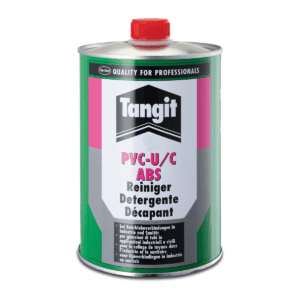
- Solvent cleaner PVC-U/C ABS 0.125 ltr — a cleaning fluid for preparing pipe ends and fitting sockets before solvent cementing, supplied in a small tin for occasional or single-project use.
- Pipe thread sealant Uni-Lock nylon fibre white 80 m, DVGW/WRAS — a nylon fibre sealing thread on a dispenser, wound into male threads to seal metal and plastic threaded connections.
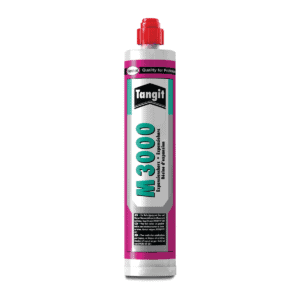
- Expansion resin grey M3000, 300 ml — a grey cartridge resin for filling, anchoring and sealing work around pipe penetrations and fixings.
- Two-component adhesive gun type PP 6 — a manual dispensing gun for two-component cartridges, so that both components are driven forward together.
- Nozzle set FP504, 10 pcs — replacement mixing nozzles, because a nozzle that has been left on a cartridge is normally a write-off.
Solvent welding PVC-U pipework the right way
A solvent cement joint is not glue in the everyday sense; the two plastic surfaces fuse, which is why surface preparation matters more than the amount of cement applied. Cut the pipe square, remove burrs and chamfer the outside edge lightly so the pipe enters the socket without scraping cement away. Then wipe both the spigot and the socket with solvent cleaner on a lint-free cloth to remove dust, release agent, grease and handling marks. Dry-fit first to confirm the pipe reaches the correct depth in the fitting, mark the insertion depth if the alignment of a fitting matters, and keep the working area ventilated.
Check the marking on the pipe and fitting before you start. Pool pipework is commonly PVC-U in imperial outside diameters such as 50 mm, 63 mm and 75 mm, and the cleaner listed here is intended for PVC-U, CPVC and ABS surfaces. Polyethylene and polypropylene pipework cannot be solvent welded at all and is joined mechanically or by fusion instead, so if a system turns out to be PP or PE, a different approach is needed.
Sealing threaded connections
Threaded joints appear wherever a pump, a heater, a pressure gauge, a drain plug or a union meets plastic or metal pipework. A nylon fibre sealing thread is wound around the male thread, crossing over itself along the length of the engagement so that the fibre fills the gap as the joint is tightened. It is easy to meter, it does not run, and the dispenser means there is no half-used roll flapping about in the toolbox. Clean the threads first, do not over-tighten plastic fittings, and avoid winding sealant over damaged or cross-cut threads — those are better replaced.
Two-component cartridges, guns and nozzles
Two-component products only work if the components leave the cartridge in the correct ratio and pass through a mixing nozzle on the way out. That is what the type PP 6 gun and the FP504 nozzle set are for. Keep spare nozzles with the cartridge: once the resin in a used nozzle has set, the nozzle is finished even though the cartridge may still be perfectly serviceable. When ordering nozzles, match the set to the cartridge system you are already using rather than to the colour or size of the nozzle alone.
Tangit at PoolParthub.com
Here you will find the jointing consumables that tend to run out halfway through a job: cleaner for solvent weld preparation, sealing thread for the unions and gauges, a cartridge of expansion resin, a dispensing gun and the mixing nozzles that go with it. They are stocked because they are the small items that hold an entire circulation system together, and because replacing one of them is far cheaper than chasing a slow leak later.
If you are unsure which product suits a particular joint, work from the pipe material and the type of connection — solvent socket or thread — and read the manufacturer’s instructions on the packaging before use. Ordering the cleaner, the sealant and a spare nozzle set together at the start of a project is usually the least frustrating way to begin.