


Azud
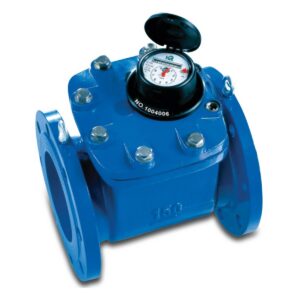


Azud water meters and pressure instruments for pool and filtration systems
Measurement is the quiet part of pool and filtration engineering. A flow meter tells you how much water has passed through a line; a pressure gauge tells you what is happening inside the filter right now. Together they turn guesswork into maintenance you can plan. Here we list the Azud-related metering and instrument items, including a flanged Woltman water meter and glycerin-filled pressure gauges from Profec that are commonly fitted to the same manifolds and filter stations.
What the range covers
The selection is deliberately compact and built around two jobs: totalising flow on a larger pipe run, and reading working pressure at the point where it matters. The items currently listed are:
- Azud Woltman water meter brass DN80 flange 16 bar MID — a flanged volumetric meter for a DN80 line, rated 16 bar and MID marked, supplied in brass with a blue register.
- Profec glycerin-filled pressure gauge 0–10 bar — bottom entry, 1/4″ BSP connection, for systems where readings can approach or exceed 6 bar.
- Profec glycerin pressure gauge 0–6 bar — bottom entry, 1/4″ male BSP, a common choice for sand filters, cartridge housings and pump manifolds that run at low pressure.
Woltman meters and where they fit
A Woltman meter uses a helical turbine set in the flow path, which is why this design is favoured on larger diameters where high throughput and low head loss matter more than measuring very small trickles. On a DN80 flanged line that typically means a main supply into a plant room, a backwash feed, a top-up line for a large basin, or a sub-meter on a filtration skid where water use needs to be recorded separately from the rest of the building.
The MID marking on the register indicates the meter is intended for use where volumes are measured for billing purposes, rather than purely for internal monitoring. Flanged connection makes installation on steel or PVC-C pipework straightforward with the matching counter-flanges, and it allows the meter to be removed for inspection without cutting pipe. As with any turbine meter, a straight run of pipe upstream and downstream helps readings stay stable, and a strainer ahead of the meter protects the rotor from debris pulled in after works on the system.
Why glycerin-filled gauges last longer
Pump rooms are a hostile place for instruments. Every start-up sends a pressure spike down the line, and a running pump creates constant low-level pulsation that wears a dry gauge movement out and makes the needle flutter so much it is hard to read. Filling the case with glycerin damps that movement: the pointer settles, the mechanism is cushioned, and condensation inside the window is reduced.
Both gauges listed here use a bottom (radial) entry with a 1/4″ BSP thread, which is the most common arrangement on filter heads, multiport valves, pressure vessels and pump housings across Europe. Choose the range so the normal working pressure sits roughly in the middle of the dial — a 0–6 bar gauge suits most sand and cartridge filters that operate between 0.8 and 2 bar, while 0–10 bar gives headroom on booster sets, pressurised feed lines or systems with higher static pressure.
Choosing and identifying the right part
Before ordering, check the following against the fitting you already have:
- Nominal diameter — confirm the pipe and counter-flange are DN80; a meter cannot be adapted down without changing the flow profile it was designed around.
- Pressure rating — the system working pressure, plus spikes, must stay below the 16 bar rating of the meter and within the dial range of the gauge.
- Thread and entry — measure the existing gauge port and note whether the connection leaves the case at the bottom or the rear; both gauges here are bottom entry, 1/4″ BSP.
- Mounting space — allow for the face-to-face length of a flanged meter and for straight pipe either side, and make sure the gauge dial can be read from standing height.
- Replacement of a failed unit — a misted window, a needle that no longer returns to zero, or a register that has stopped counting all indicate the instrument should be swapped rather than cleaned.
Azud at PoolParthub.com
Here you will find the Azud metering items together with the glycerin-filled pressure gauges that are usually fitted alongside them, so a filter station can be re-instrumented from one place rather than sourced piece by piece from different suppliers.
The focus is on the parts that genuinely wear out or need replacing during the life of a pool installation: gauges that have clouded, flooded or lost accuracy, and meters on larger diameters where the flanged format keeps future service simple. If you are unsure which pressure range or connection suits your filter, note the thread size and the pressure the system normally shows, and compare it with the specifications listed on each product page.