


Profec









Profec PVC-U valves, flanges and pipework components
Profec supplies the grey PVC-U plumbing that sits between a pool, its filter and its pump: ball valves, flanges, blind flanges and the pressure pipe fittings that join them. The parts follow the metric PVC-U standard used across Europe, so outside diameters run in the familiar steps of 16, 20, 25, 32, 40, 50, 63, 75, 90 and 110 mm and on upwards to 125, 140, 160 and 225 mm for larger installations. Because the dimensions are standardised, these components can be used to extend, repair or modernise an existing circuit without replacing the whole pipe run.
Here you will find the two families that dominate the range: solvent-weld ball valves of the Type 2000 series, and DIN flange components including blind flanges for closing off a branch or pressure-testing a line.
What the range covers
With several hundred references, the assortment is built around a small number of part types repeated through every size and pressure class. In practice, most searches land on one of the following:
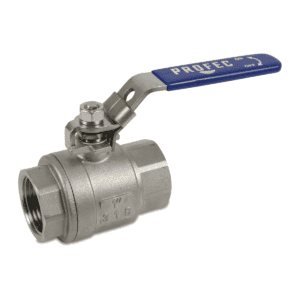
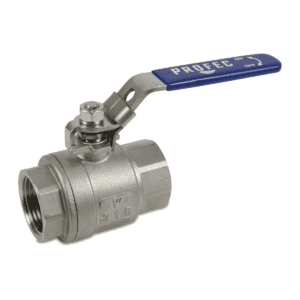
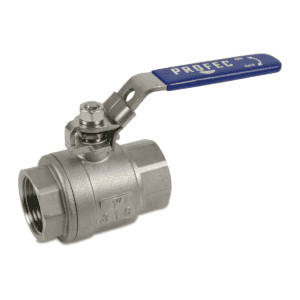
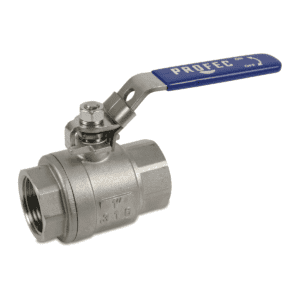
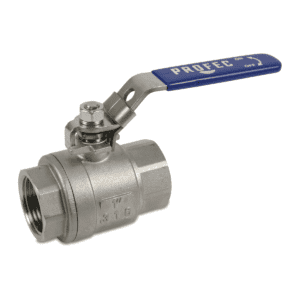
- Ball valves Type 2000 — PVC-U with glue socket ends, from 16 mm (DN15) up to 110 mm (DN80), for isolating pumps, filters, heat exchangers and backwash lines.
- Blind flanges — PVC-U DIN flanges from DN50 x 63 mm through to DN200 x 225 mm, used to cap a flanged connection or blank an unused port.
- Flange components and adaptors — parts that convert a solvent-weld pipe end into a bolted, demountable joint.
- Pressure fittings — the elbows, tees, sockets, reducers and unions needed to complete a run in the same material and pressure class.
Reading the size: outside diameter, DN and bar rating
Every description carries two numbers, and mixing them up is the most common ordering mistake. The millimetre figure is the pipe outside diameter the socket accepts; the DN figure is the nominal bore of the valve or flange. A 63 mm valve is DN50, a 75 mm valve is DN65, and both 90 mm and 110 mm valves are described as DN80 in this series. Measure the outside of your existing pipe with a caliper and order to that figure.
Pressure ratings follow the usual PVC-U pattern: the smaller sizes up to 63 mm are rated 16 bar, while the larger diameters from 75 mm upwards are rated 10 bar. Flanges appear as PN10 or PN10/16 depending on size. Pool circulation pressures are far below these figures, but the rating still matters when matching a new part to existing pipe and when choosing bolt patterns, since PN10 and PN16 flanges are not always interchangeable.
Solvent-weld joints and what wears out
Glue socket ends are joined with PVC-U cleaner and solvent cement. The joint itself does not wear, which is why the parts that need replacing on an ageing pool circuit are almost always the moving and sealing components rather than the pipe. On a ball valve, the handle, the stem seal and the seat seals take the strain; a valve that drips from the spindle or becomes stiff to turn is usually a sealing issue rather than a failed body. Before ordering a replacement, note the size marking cast into the valve body and the series name, and check the diameter of any O-ring you remove so the new one matches.
A few points worth checking when selecting:
- Operate valves regularly — valves left in one position for a full season can stiffen.
- Allow access — leave enough clearance around a valve for the handle to swing and for later removal.
- Use unions or flanges at pumps, filters and heaters so the equipment can be taken out without cutting pipe.
- Match the seal material to anything dosed into the line, particularly where chemicals are injected.
Profec at PoolParthub.com
Here we list the Profec PVC-U programme as it is used in pool and water treatment installations: Type 2000 ball valves from 16 to 110 mm, blind flanges from DN50 to DN200, and the flange and pressure fittings that go with them. Sizes are listed individually so a single replacement can be ordered rather than a complete set.
The range is kept broad because repairs rarely follow a pattern — one job needs a 50 mm isolating valve, the next a DN100 blind flange to blank an old return. Work from the outside diameter of your pipe and the DN marking on the part you are replacing, and the correct reference is straightforward to identify.