


Pool-I.D.




Pool-I.D. water testing tablets, strips and pooltesters
Water balance is the one piece of pool maintenance that cannot be judged by eye. Chlorine can look fine and read far too low; pH can drift far enough to make the disinfectant sluggish and the water uncomfortable long before anyone notices. Pool-I.D. covers this part of the job with reagent tablets, dip-and-read strips and a hand-held comparator tester, so the same brand can serve a simple above-ground pool and a pool with salt electrolysis or an active oxygen treatment.
What the range covers
Here you will find the two classic reagent tablets together with a set of multi-parameter strips and a comparator kit:
- DPD No 1 tablets – the standard reagent for free chlorine, supplied in packs of 50 and 100 pieces.
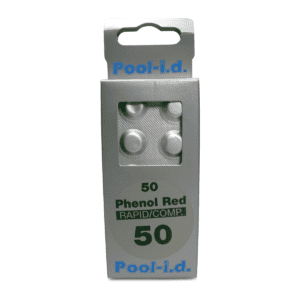
- Phenol red tablets – the companion reagent for pH, also in 50 and 100 piece packs.
- Pooltester type 6 – a comparator tester for pH, chlorine and bromine, supplied with 20 + 20 tablets so it is ready to use.
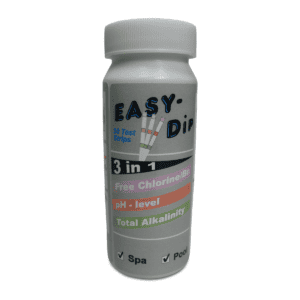
- TSL 100 strips – 3-in-1, for pH, free chlorine or bromine and alkalinity, 50 pieces.
- TSL 200 strips – 3-in-1, for pH, active oxygen and alkalinity, 50 pieces, for pools treated without chlorine.
- TSL 600 strips – for salt (NaCl) content, 20 pieces, intended for pools with a salt chlorinator.
- TSL 700 strips – 5-in-1, for pH, free chlorine or bromine, alkalinity, total hardness and cyanuric acid, 50 pieces.
Tablets or strips: which to use when
Tablet testing with a comparator is the method most pool professionals fall back on when a figure has to be trusted. A measured water sample is taken in the test chamber, the tablet is crushed into it, and the colour that develops is compared with the reference block. DPD No 1 handles free chlorine, phenol red handles pH, and the two chambers of a pooltester let both be read side by side from the same sample of water.
Strips are the faster option for routine checks. One dip gives several values at once, which makes them practical for a daily look at the water before anyone swims. The 3-in-1 TSL 100 suits the usual chlorine or bromine pool. The TSL 200 is the one to pick if the pool runs on active oxygen, since it reads that instead of chlorine. The TSL 700 adds total hardness and cyanuric acid, the two values worth checking a few times a season rather than daily: stabiliser builds up over time and hard fill water shows up in scaling. The TSL 600 is a single-purpose strip for salt, used to see whether the electrolysis cell is being fed the concentration it needs.
Getting a reading you can rely on
A few habits make the difference between a number and a guess. Take the sample from elbow depth away from the return jets, not from the surface next to the skimmer. Rinse the test chamber with pool water first, and handle tablets from the foil rather than with wet fingers, as skin moisture and sun cream will corrupt the result. Crush the tablet fully and mix until no particles remain. With strips, dip briefly, hold level and read within the time printed on the tube, then close the tube immediately — the desiccant inside only works if the cap is shut.
Reagents do not last indefinitely. Tablets and strips both age, so buying the pack size that matches how often you actually test is sensible: the 50 piece packs suit a single domestic pool, while the 100 piece packs make sense for a longer season, a larger installation or more than one pool. If readings start behaving oddly, replacing the reagent is the first thing to rule out before adjusting anything in the water.
Pool-I.D. at PoolParthub.com
Here we stock the refill tablets, the multi-parameter strips and the comparator tester together, so a tester bought years ago can be kept in service with fresh DPD No 1 and phenol red rather than replaced. Check which reagent your comparator calls for and how many chambers it has before ordering, and match the strip to the treatment your pool actually uses.
Because testing consumables are used up steadily through the season, it is worth keeping a spare pack alongside the tester. A set of strips for quick daily checks and tablets for the readings that matter is a combination that covers most pools without complication.