


Szivattyúk
-
 Price on request
-
 Price on request
-
 Price on request
-
 Price on request
-
 Price on request
-
 Price on request
-
 Price on request
-
 Price on request
-
 Price on request
-
 Price on request
-
 Price on request
-
 Price on request
-
 Price on request
-
 Price on request
-
 Price on request
-
 Price on request
-
 Price on request
-
 Price on request
-
 Price on request
-
 Price on request
Pump spare parts and exploded views
A pool pump is the one component that runs every day of the season, so it is also the component that sends most people looking for a replacement part rather than a replacement machine. The exploded views gathered here break each pump down into its individual components, from the motor and impeller through to the lid seal and the smallest fixing screw, so that a single worn item can be identified and ordered on its own. Listings cover domestic circulation pumps, variable-speed models, counterflow and air blower units, and the prefilters and accessories that sit alongside them.
Which pumps are covered
The range is built around AstralPool pumps and the families most often found on European pools. Among them you will find the Viron series, including the P300 speed pool pump, the P320 and the P600, the Verdon VS in 1HP and 2HP versions, and the long-running Superstar pumps. Alongside the filtration pumps sit Turbo air blower pumps in several power ratings for air-bed and hydromassage use, vertical counterflow pumps for swim-jet installations, and Prefilter 11L Bronze units that protect the pump from leaves and hair.
- Filtration pumps: Viron P300, P320 and P600, Verdon VS 1HP and 2HP, Superstar and comparable single- and two-speed models.
- Counterflow pumps: vertical units used on swim jets, where flow rate matters more than head.
- Air blowers: Turbo blower pumps in varying kW ratings, single-phase and three-phase.
- Prefilters and strainers: 11L bronze bodies, lids, baskets and seals fitted upstream of the pump.
- Dosing and cleaning accessories: Sprint Chlore and Sprint Sweep units that share mounting and connection parts with the pump line.
Parts that wear out first
Most pump faults come down to a handful of consumable items rather than the motor itself. A pump that loses prime or drips from the front of the housing usually needs a mechanical shaft seal; a pump that will not hold vacuum is more often suffering from a hardened lid seal or a cracked prefilter lid. Noise and a drop in flow point towards a damaged impeller or a blocked diffuser.
- Mechanical shaft seals: the standard wear item on any centrifugal pool pump, and the usual cause of water appearing between motor and pump body.
- Lid and body O-rings: flatten and harden over seasons of heat and chlorine, letting air into the suction side.
- Impellers and diffusers: suffer from grit, metal debris and dry running.
- Strainer baskets: brittle after long UV exposure; a split basket lets debris reach the impeller.
- Drain plugs, unions and gaskets: small, cheap and responsible for a surprising share of leaks.
- Motor electrics: capacitors, terminal covers, fan covers and fixing hardware.
Identifying the correct component
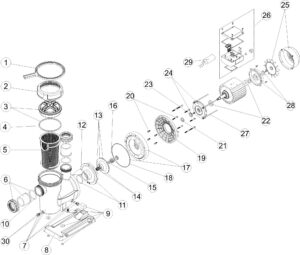
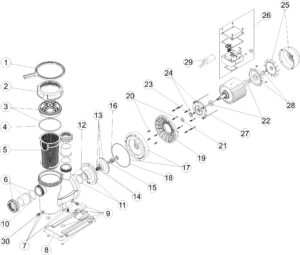
Exploded views work on position numbers. Find the drawing for your pump, locate the item you need on the diagram, then match that position to the part listed. Because many series share a housing but differ in motor and impeller size, the model name alone is rarely enough: note the full designation and, where it is visible, the reference code stamped or printed on the motor plate or housing. Codes such as 56552, 75361 or 10403T distinguish variants that look identical from the outside.
If the drawing for your unit is not obvious, measuring is the next best approach. Seals should be measured at inner diameter, outer diameter and cord thickness; shaft seals by the shaft diameter they run on. For prefilters, measure the lid diameter and the thread or clamp type. Photographing the old part next to a rule before fitting the new one saves a second order later, and keeping the previous seal as a reference makes future servicing quicker.
Pumps at PoolParthub.com
Here we list pump components across more than three hundred references, from complete replacement pumps such as the Viron P600 and Verdon VS down to individual seals, baskets, impellers, lids and motor fittings. Exploded views are grouped by model family so that owners of older Superstar, counterflow and Turbo blower units can still work out what fits.
The aim is simple: keep a working pump working. Repairing a pump with the correct seal or impeller costs a fraction of replacing it, and the diagrams on these pages exist so that the right position number can be found without guesswork, whether the job is a routine seal change or tracking down a part on an installation fitted years ago.