


Zealux
-
 1.299,00 €1.073,55 €
-
1.399,00 €1.156,20 €
-
1.699,00 €1.404,13 €
-
1.999,00 €1.652,07 €
-
 2.499,00 €2.065,29 €
-
2.799,00 €2.313,22 €
Zealux pool heat pumps and inverter models
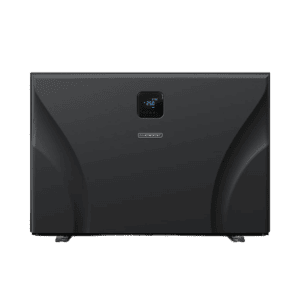
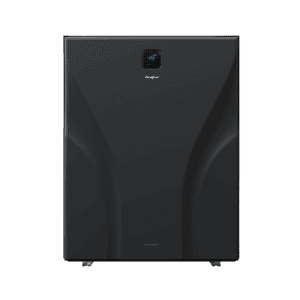
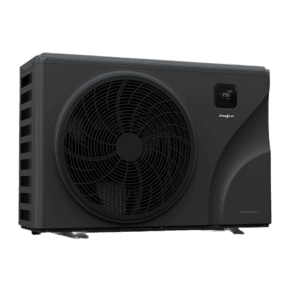
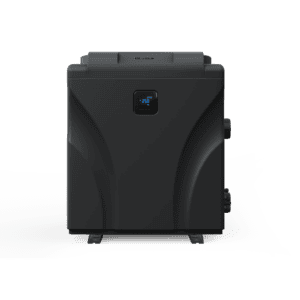
Here you will find the Zealux range of air-source pool heat pumps, from compact units for small private pools up to three-phase machines intended for large private and semi-commercial basins. The range is built around full inverter technology, which means the compressor and fan speed adjust to the heating demand instead of simply switching on and off. In practice that gives a gentler ramp-up, steadier water temperature and lower noise when the unit is running at part load, which matters when the heat pump sits close to a terrace or a neighbouring garden.
Three families make up the listing: the UX Series, available as single-phase units and as higher-output three-phase models, the VX Series in a vertical cabinet, and the Inverboost series with its numbered models such as the 145P, 165P, 215P, 255P and PBS 305P. Outputs across the range run from around 11 kW to 40 kW, so most pool sizes and heating seasons can be matched without over- or undersizing.
The series explained
- UX Series full inverter — the broadest family here, with 11, 14, 17, 21, 26 and 30 kW single-phase options and 26, 30, 35 and 40 kW three-phase versions for larger volumes or where the electrical supply favours a balanced three-phase load.
- VX Series full inverter — vertical-cabinet units at 16, 26 and 30 kW. The vertical format discharges air upwards, which is useful where the available footprint is narrow or where a horizontal fan would blow directly at a wall, fence or seating area.
- Inverboost full inverter — the 145P (14.5 kW), 165P (16.5 kW), 215P (19.5 kW), 255P (24.5 kW) and PBS 305P (28.5 kW), where the model number follows the nominal capacity.
Choosing the right output
Sizing is the single most important decision. A heat pump that is too small will struggle to reach target temperature in spring and autumn, while one that is heavily oversized costs more to install than it needs to. The main factors are:
- Volume d'eau — calculate length × width × average depth in metres for a rectangular pool, and work from the manufacturer’s figure for a shaped or freeform shell.
- Season and climate — a pool used from June to August in a warm region needs far less capacity than one heated from April to October in northern Europe.
- Couverture — a solar or insulating cover dramatically reduces overnight heat loss and is the cheapest way to get more out of any heat pump.
- Exposure — wind across the surface and a shaded position both increase losses.
- Electrical supply — check the available single-phase current before choosing a large single-phase unit; the three-phase UX models exist precisely for installations where that is the easier route.
Installation and running considerations
Heat pumps are installed on the pressure side of the filtration circuit, after the filter and after any dosing or salt chlorination equipment, with the water flow matched to the unit’s requirement. They need free air on the intake and discharge sides so the cooled air is not drawn straight back in, a level and stable base, and a route for condensate to drain away. Bypass valves are strongly recommended: they let the flow through the exchanger be tuned and allow the unit to be isolated for winterising without draining the whole circuit.
Because the compressor modulates, a full inverter unit is usually run for longer periods at lower speed rather than in short bursts. Keeping the filtration cycle long enough to cover the heating period, cleaning the filter regularly and maintaining balanced water chemistry all protect the heat exchanger and keep performance consistent over the seasons.
Zealux at PoolParthub.com
Here we list the current Zealux full inverter line-up — UX Series in single-phase and three-phase, the vertical VX Series and the Inverboost models — covering outputs from roughly 11 kW up to 40 kW. Having the whole range side by side makes it straightforward to compare capacities and cabinet formats before committing to a size.
If an existing unit is being replaced, note the model name and the nominal kW from the rating plate and compare it with the equivalent current model, then check that pipe connections, electrical supply and the available space around the installation still suit the new cabinet. Where a detail is unclear, the model designation on the plate is the quickest way to identify what is already installed.