


Da saldare
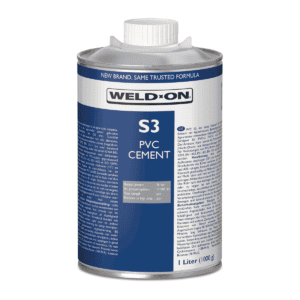


Weld-On solvent cement and cleaner for PVC pool pipework
Almost every pressurised pool circuit is built from rigid PVC pipe and fittings, and every one of those joints depends on a chemical weld rather than a mechanical seal. Solvent cement softens the surface of the pipe and the socket, the two layers fuse, and the joint becomes a continuous piece of plastic. Get the preparation right and the pipework outlasts the pump; skip the cleaning step or use the wrong product and the same joint will weep under pressure within a season.
Here you will find the Weld-On Saba range used for exactly that job: a PVC solvent cement in the S3 grade and a matching PVC and ABS solvent cleaner, both offered in small, medium and bulk tins so the quantity suits the work in hand.
Cosa comprende la gamma
The products fall into two complementary groups, and in practice they are bought together rather than separately.
- Colla a solvente per PVC Saba S3 – supplied in 250 ml and 1 litre tins with a brush fitted in the lid, and in a 5 litre tin without a brush for larger installations. The tins carry KIWA marking, which is the Dutch certification mark you will frequently see on jointing products used in pressure pipework.
- SabaClean PVC and ABS solvent cleaner – available in 0.25 litre, 0.65 litre and 5 litre containers. This is the preparation fluid used to remove grease, release agents, dust and surface contamination from the pipe end and the socket before any cement is applied.
The cleaner is suitable for both PVC and ABS surfaces, which is useful where a pool room contains a mix of rigid PVC pipe runs and ABS valve or fitting bodies that still need degreasing before assembly or before an adhesive repair.
Choosing between the tin sizes
Size selection is mostly about how much work you have and how quickly you will use the tin, since any solvent product begins to thicken once it has been opened and resealed repeatedly.
- 250 ml cement with brush – for a service call, a single pump or filter swap, or a handful of 50 mm and 63 mm joints.
- 1 litre cement with brush – a sensible standard tin for a full equipment set, a manifold or a filter change where a dozen or more joints are made in one visit.
- 5 litre cement without brush – for new installations and larger diameter pipework, where a separate applicator brush or dauber sized to the pipe is used. Larger sockets need a brush roughly half the pipe diameter so that enough cement is laid on in one pass.
- 0.25 and 0.65 litre cleaner – convenient for the van and for intermittent repair work.
- 5 litre cleaner – matches the bulk cement tin for construction and refurbishment projects.
Making a sound solvent-weld joint
The sequence matters more than the speed. Cut the pipe square, remove the burr inside and out, and chamfer the leading edge slightly so the pipe does not scrape the cement out of the socket as it enters. Dry-fit first and mark the insertion depth with a pencil.
Wipe both the pipe end and the inside of the socket with the cleaner on a lint-free cloth and let the surfaces flash off. Apply cement evenly to the pipe and more sparingly to the socket, assemble immediately with a slight twist, and hold the joint firm until it stops trying to push back out. Wipe away the surplus bead. Always follow the setting and pressurising guidance printed on the tin, as both depend on pipe diameter, ambient temperature and humidity — cold and damp conditions slow everything down considerably.
Storage, handling and shelf life
Solvent cement and cleaner are flammable and release vapour, so they are worked with in ventilated spaces, away from ignition sources, with the lid closed between joints. Keep tins upright, cool and tightly sealed; cement that has gelled or become stringy should not be thinned down and reused, as the solvent balance that makes the weld work has already changed. Buying a tin size that matches the job is the simplest way to avoid waste.
Weld-On at PoolParthub.com
Stocked here are the Saba S3 PVC solvent cement in 250 ml, 1 litre and 5 litre tins, and the SabaClean PVC and ABS solvent cleaner in 0.25, 0.65 and 5 litre containers — the consumables that sit behind every piece of pool pipework we supply fittings for.
They are listed because a filter, pump or valve is only as reliable as the joints that hold it in the circuit. Ordering the cleaner alongside the cement, in sizes that match the scale of the installation, is the least expensive insurance a pool installer can buy.